


For one extraordinary night in Davos, Africa was not a subject on the global agenda. Africa entered the room as a creative force — contemporary, confident, sophisticated and entirely capable of telling its own story.
There are moments in a career when the significance of what you are doing only becomes fully apparent years later. At the time, you are consumed by the practical realities — the artists, the production schedules, the screens, the lighting, the logistics, the deadlines, and the hundreds of small decisions that somehow have to become one seamless experience.
With distance, however, some of those moments begin to reveal themselves as part of a much larger story.
For me, CELEBRATE AFRICA, created through the partnership between MTV and the World Economic Forum in Davos, Switzerland, in January 2007, was one of those moments.
High in the Swiss Alps, some of the most influential political, economic and business leaders in the world had gathered for the World Economic Forum Annual Meeting. Presidents and prime ministers sat alongside global chief executives, technology pioneers, economists, philanthropists, development leaders, academics, activists and cultural figures, all debating a world whose traditional centres of economic and political influence were visibly beginning to change.
The theme of the 2007 gathering seemed almost perfectly suited to what we were about to bring into that environment: “Shaping the Global Agenda: The Shifting Power Equation.”
Into that conversation, MTV Networks Africa brought another expression of changing global power, the cultural power of a young, contemporary, creative and increasingly confident Africa.
CELEBRATE AFRICA became an opportunity to bring African music, imagery, youth culture, film, fashion, design and storytelling directly into one of the most powerful international meeting places in the world. Africa was already being discussed extensively at Davos through the familiar language of economics, governance, development, investment, healthcare, conflict and poverty. Those conversations mattered, but I had always believed that another Africa needed to enter those rooms too: the Africa of artists and filmmakers, musicians and designers, cities and nightlife, television and fashion, imagination and youth culture. The Africa already creating its own future.For one remarkable night in Davos, we wanted that Africa to become impossible to ignore.
The Africa we wanted Davos to encounter was not waiting for its future to arrive. Across the continent, a new generation was already creating it.
The significance of CELEBRATE AFRICA cannot really be separated from the history and influence of the institution with which we were partnering.
The World Economic Forum had begun in 1971, when Professor Klaus Schwab convened what was originally called the European Management Symposium in Davos. What started primarily as a gathering around European business leadership gradually evolved into something considerably larger.
Political leaders entered the conversations, international institutions became involved, and Davos increasingly became a meeting place where government, business, civil society and academia could confront questions that crossed borders, industries and political systems.
By 1987, the organisation had become the World Economic Forum, a name that reflected the scale of the international role it was beginning to occupy. Over the decades, Davos developed into one of those rare environments where political leaders might find themselves talking directly with technology entrepreneurs, where multinational CEOs could sit alongside development activists, and where economic policy could collide with conversations about climate, health, poverty, geopolitics, technology and culture.
By January 2007, the Annual Meeting had become one of the most concentrated gatherings of global influence anywhere in the world.
That year’s meeting ran from 24 to 28 January 2007, bringing approximately 2,400 participants into Davos, including hundreds of chief executives and senior business figures together with heads of state and government.
Among the international figures participating were German Chancellor Angela Merkel, British Prime Minister Tony Blair, South African President Thabo Mbeki, King Abdullah II of Jordan, Palestinian President Mahmoud Abbas, Pakistani Prime Minister Shaukat Aziz and Lebanese Prime Minister Fouad Siniora. The wider gathering also included some of the world’s most influential business and technology personalities, among them Bill Gates, Eric Schmidt, Sergey Brin and Rupert Murdoch, alongside politicians, thinkers, philanthropists and leaders from international institutions.
Africa already occupied an important place in many of the conversations happening around Davos. Governance, trade, development, healthcare, HIV/AIDS, investment, poverty reduction and the continent’s economic prospects were being discussed in rooms filled with people whose decisions could materially affect the direction of nations and industries. Yet so much of the international relationship with Africa was still framed around what the continent lacked, what needed to be fixed, or what the outside world believed Africa needed to become.
We wanted to introduce another perspective.
We were not taking Africa to Davos as somebody else’s entertainment. We were taking Africa into the room as the author of the experience.
MTV Base had launched across sub-Saharan Africa only two years earlier, in 2005, and those first years remain some of the most exhilarating of my career. We were not simply launching another television channel; we were participating in the construction of a new cultural bridge.
For decades, the dominant direction of global entertainment had largely been inward. International music, television, artists and Western popular culture travelled into Africa. African audiences knew American and European stars intimately, often while extraordinary African artists from neighbouring countries struggled even to cross their own borders.
From the beginning, one of our ambitions at MTV Base was to help change that direction of travel. African artists needed to move outward. African stories needed to move outward. African presenters, musicians, directors, designers and creative voices needed access to the same international cultural ecosystem that had spent decades broadcasting into the continent.
Davos offered an extraordinary opportunity to push that ambition into an entirely different arena.
At the time, I was MTV Networks Africa’s Head of Events, Marketing and Digital Media, and I oversaw the CELEBRATE AFRICA campaign and its executive production, working closely and in equal partnership internally across departments with Macky Drese and Eazy Bailey from the MTV Networks Europe and International Marketing and Events leadership team.
That partnership became fundamental to the success of the project. CELEBRATE AFRICA was never approached as an African regional team arriving in Switzerland merely to provide the entertainment component of an international conference. Macky, Eazy and I worked across the creative, production, marketing and event architecture as equal partners, bringing together our respective teams, experience and resources across Africa, Europe and the wider international MTV network.
Under the broader leadership of Alex Okosi, Vice President and General Manager of MTV Networks Africa, we could combine the cultural instincts and understanding of our African operation with the enormous international infrastructure and experience available throughout MTV Networks.
That was one of the things I loved most about MTV during those years. When it worked at its best, geography disappeared. Johannesburg could speak directly to London. London could connect to New York. An idea rooted deeply in Africa could move through a global organisation without necessarily losing its identity along the way.
CELEBRATE AFRICA required exactly that kind of partnership because we were thinking about much more than a concert. The entire environment needed to communicate the story. From the moment delegates entered, the architecture, screens, lighting, music, imagery and performances all needed to begin changing their perception of where they were.
The room itself became part of the storytelling, a clear open Davos canvas gradually overtaken by the colour, sound, movement and imagination of contemporary Africa.
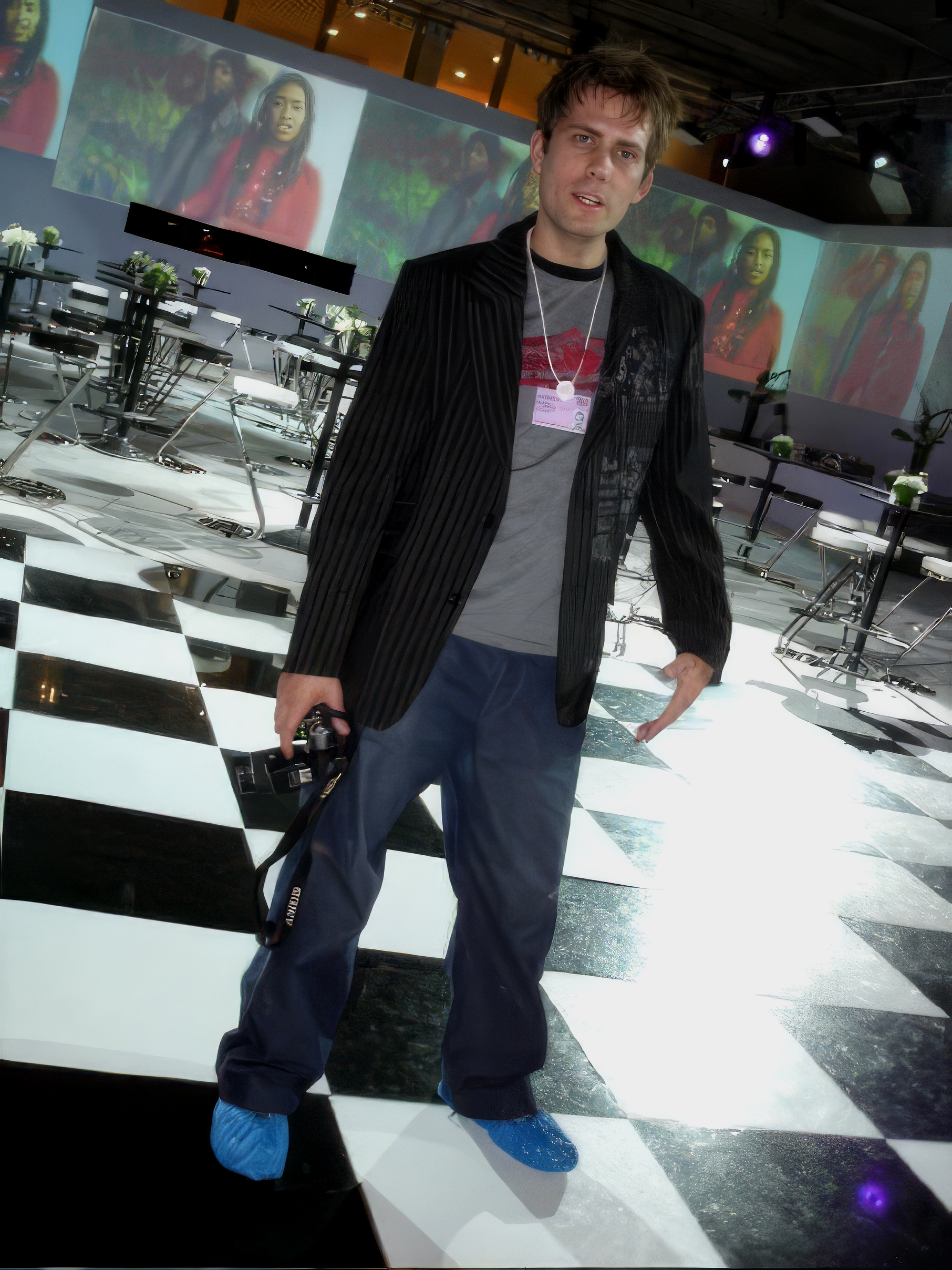
The creative starting point was the physical neutrality of the Davos environment itself. Its clean, restrained and largely white architectural language gave us an extraordinary canvas, and against it we began introducing colour, movement, film, music and imagery from across Africa. Large projection surfaces and screens became windows into the continent. African music videos, MTV performance footage, films, graphics, photography and fragments of contemporary visual culture moved continuously around the environment, transforming surfaces that had spent the previous days surrounding economic panels and political discussions into an immersive African visual experience.
I never wanted the event to fall into the trap of decorating an international venue with easily recognisable clichés and simply calling it African. The continent was far too complicated, modern and creatively interesting for that. Africa is not one colour palette, one pattern, one musical genre or one cultural identity. Johannesburg does not feel like Lagos. Lagos does not feel like Dakar. Dakar does not feel like Nairobi. Nairobi does not feel like Accra.
Every city has its own language, energy, contradictions and rhythm, and even within those cities there are dozens of different cultural worlds living alongside one another.The creative challenge was therefore not to reduce Africa into convenient visual shorthand, but to allow that multiplicity to become part of the experience.
The soundtrack moved between South African kwaito, Ghanaian hiplife, Senegalese m’balax, East African sounds, African jazz, soul, hip-hop, R&B, rock and dancehall, while the imagery moved between cities and landscapes, musicians and fashion, performance and street culture, television and youth identity. A temporary floor was constructed across a large pool within the venue, turning another existing architectural feature into part of the production and allowing the event to expand physically through the space.
Screens, projection, lighting, staging, film and music became interconnected elements rather than separate pieces of decoration. Gradually, the environment stopped feeling like an international conference centre and became something warmer, less predictable and much more alive.
We were not attempting to reproduce Africa inside Switzerland, no event could ever do that. We wanted to communicate something of its confidence, its energy, its diversity and its contemporary creative momentum strongly enough that people could feel it before anyone needed to explain it.
Aṣa and Simphiwe Dana's authenticity made them global instantly, but firmly rooted in Africa.
At the centre of CELEBRATE AFRICA, of course, were the artists. Whatever we created around them, the stage ultimately had to belong to Africa.
As happens frequently with major international productions, the artist configuration developed and changed as the event moved from its initial planning stages toward the final show. Early communications surrounding CELEBRATE AFRICA referenced a broader African lineup that included 2Face Idibia, Simphiwe Dana and other talent, while the final live musical story in Davos became particularly associated with Aṣa and Simphiwe Dana.
It was a combination that beautifully expressed what we were trying to say.
Aṣa, the French-Nigerian singer-songwriter whose artistic story was profoundly shaped by Lagos, represented a generation of African musicians capable of moving naturally between worlds without surrendering the character that made their music distinctive.
Her sound carried soul, folk, jazz and African musical traditions, but what struck me most was its intimacy. Aṣa did not require excess. Her strength was in the song, the voice and the honesty of the performance.
In an environment such as Davos, that simplicity could be incredibly powerful. Surrounded by people who had spent days moving between presentations, negotiations and formal discussions, suddenly there was simply an African artist, a song and a room listening.
Simphiwe Dana brought another extraordinary dimension to the evening. Emerging from South Africa with a voice and musical identity unlike almost anything around her at the time, she drew from jazz, soul and traditional African musical language while creating something unmistakably her own.
There was intelligence and emotional depth in her music, but there was also a fierce contemporary African confidence.
Neither Aṣa nor Simphiwe needed to become less African in order to belong in an international environment. In fact, the opposite was true. The more authentically themselves they were, the more powerful their presence became.
Around those performances, the musical journey continued through African music and DJ culture, gradually taking the atmosphere away from the formality associated with an international summit and towards something much more communal.
Delegates who had spent several days discussing geopolitical and economic change were suddenly standing together inside a room driven by African rhythm.
Music has an extraordinary ability to dismantle hierarchy. A president, a CEO, an activist and a musician can suddenly occupy the same space, responding to the same sound. For a few moments, titles and institutions matter less.
Culture can sometimes move perception faster than policy: a song, a face, a film or a room transformed can make a continent human again.
One principle sat beneath almost every creative decision we made around CELEBRATE AFRICA: Africa could not merely become the theme of somebody else’s event. Africa needed to become the author of the experience.
That distinction mattered enormously to me.
It would have been easy to create an international interpretation of Africa, familiar patterns, traditional imagery, drums, fabrics, masks and other devices capable of communicating a generic idea of the continent within seconds. But that was not the Africa we were living and working in every day.
The Africa surrounding MTV Base was Lagos nightlife and Johannesburg youth culture, Dakar style and Nairobi radio, Accra hip-hop and South African kwaito. It was television studios and nightclubs, fashion designers and music producers, filmmakers and photographers, dancers and DJs. It was a generation of young Africans simultaneously deeply connected to where they came from and completely comfortable participating in global culture.
That was the continent we wanted Davos to encounter.
The African artists were therefore not supporting characters inside a wider international production. They were the centre of the story. The music was not background. The films and imagery were not decorative wallpaper. They were all part of a larger narrative that allowed Africa to represent itself through the cultural language of a generation already building something new.
The location made that particularly significant. Many of the people inside the World Economic Forum had extraordinary influence over investment, development, corporate strategy, economic policy and the ways in which entire countries and regions were understood internationally.
Perception matters in those rooms because perception ultimately influences decisions, and culture can shift perception in ways that economics alone often cannot. A song can humanise a continent that has been reduced to statistics. A young African face moving across a giant screen can suddenly replace an abstraction. A room filled with music, film, colour and movement can communicate confidence much more immediately than another report explaining why people should believe in Africa’s future.
Long before Afrobeats and Amapiano transformed global popular culture, we could already feel the foundations moving beneath us. Africa’s cultural power was beginning to travel.
There was something particularly resonant about creating CELEBRATE AFRICA during a World Economic Forum Annual Meeting built around the idea of “The Shifting Power Equation.”
The Forum was primarily referring to political, economic and technological power, but cultural power was shifting as well.
In 2007, much of what the world now understands about the global potential of African culture was still ahead of us. Afrobeats had not yet become one of the defining sounds of international popular music.
Amapiano had not yet emerged from South Africa and travelled through clubs, charts and festivals around the world. African fashion, film, dance and digital creativity had not yet achieved the extraordinary global visibility that would follow.
But if you were working inside African music and youth culture at the time, you could already feel that something was happening.
The artists existed. The audiences existed. The ambition existed. Mobile technology was beginning to alter communication and music consumption. African television was becoming more sophisticated and increasingly pan-African.
Music that had traditionally remained confined within particular countries was beginning to travel across borders.
MTV Base became one of the platforms helping to connect those movements. We were creating VJ searches that discovered new African television personalities, producing live tours and events across multiple countries, creating music-video projects, developing new television shows, building brand partnerships, connecting African performers with international artists and creating routes through which African talent could enter the wider global MTV ecosystem.
None of those things existed separately in my mind. Together they formed part of a larger ambition: the construction of a contemporary pan-African cultural network through which young Africans could see themselves represented, and through which their stories could increasingly travel outward.
CELEBRATE AFRICA belonged to that same journey. It was cultural diplomacy expressed through entertainment, carrying the idea that Africa should be present wherever conversations about its economic and political future were happening, but that it should enter those rooms carrying its own musicians, imagery, culture and voice.
The World Economic Forum brought the room of global influence. MTV brought the language of music and youth culture. Africa gave the meeting its heartbeat.
The World Economic Forum and MTV were, on the surface, extraordinarily different institutions. One operated primarily through economics, policy, business, diplomacy and international institutional relationships. The other operated through television, music, youth culture, entertainment and emotion.
Yet both understood something fundamental about bringing people together. The World Economic Forum assembled presidents, ministers, corporate leaders, economists, entrepreneurs, technologists, development specialists and decision-makers from across the planet. MTV understood how artists, music and popular culture could reach those same people in an entirely different way.
CELEBRATE AFRICA placed those two forms of influence inside the same room.
We were not asking delegates to attend another presentation about Africa’s creative industries. We were placing them inside the culture itself. Instead of presenting statistics explaining the extraordinary size and potential of Africa’s young population, we could put the voices, faces and music of that generation directly in front of them.
For me, this was the real power of the partnership. The World Economic Forum could create the intellectual space in which Africa’s future was debated.
MTV could bring some of the emotional reality of the continent into that conversation.
One worked through argument and analysis; the other worked through feeling. For one night in Davos, they became part of the same story.
The real ambition was never to make Africa fit comfortably inside a global room. It was to prove that Africa could enter that room on its own terms and change the atmosphere simply by being itself.
Looking back now, CELEBRATE AFRICA occupies an important place in my memories of those early MTV Networks Africa years because it captured so much of what we were trying to build at the time.
There was an extraordinary sense of possibility around those years. MTV Base itself was still young, but we were already building far beyond the television channel. We were discovering new talent through VJ searches, producing live events across Africa, taking international stars into markets they had often never visited before and, equally importantly, creating platforms for African artists to move in the opposite direction.
We were producing music videos, developing television shows, building campaigns with international brands, creating social-impact projects and expanding the representation of African artists within the wider MTV world. Each project was different, but collectively they were creating an infrastructure through which African popular culture could begin travelling further and faster.
Davos represented another frontier in that story.
As MTV Networks Africa’s Head of Events, Marketing and Digital Media, I oversaw the CELEBRATE AFRICA campaign and executive production, working closely and in equal partnership with Macky Drese and Eazy Bailey across the MTV Networks Europe and International Marketing and Events leadership structure.
That collaboration was fundamental to the project. We each brought different experiences, teams and perspectives into the work, but we were united around a common ambition: whatever we created in Davos had to feel authentically African while standing comfortably at the production level expected of one of the world’s most influential international gatherings.
It became one of those moments when the enormous geographic reach of MTV suddenly felt very small. Johannesburg and London could operate almost as neighbouring rooms. African creative thinking could move into a major European production environment without being diluted.
An idea centred on African music and contemporary culture could find itself inside the World Economic Forum, surrounded by people whose decisions shaped governments, industries and economies.
And perhaps that is what remains most important to me about CELEBRATE AFRICA. We did not need to explain Africa to Davos. We needed to create enough space for Africa to speak for itself.
It spoke through Aṣa and Simphiwe Dana, through the artists moving across the screens, through kwaito and hiplife, m’balax and jazz, soul, hip-hop, R&B, rock and dancehall.
It spoke through film, fashion, cities, movement and youth culture, and through a generation of young Africans already building the cultural future long before much of the international establishment fully understood what was happening.
For one remarkable night high in the Swiss Alps, surrounded by presidents, prime ministers, global business leaders and some of the world’s most influential institutions, Africa was not positioned as a problem waiting for somebody else to solve. It arrived as a creative force, contemporary, confident, sophisticated, diverse and entirely capable of telling its own story.
That was CELEBRATE AFRICA.
CELEBRATE AFRICA
MTV X WORLD ECONOMIC FORUM
Jandré Louw
Head of Events, Marketing and Digital Media
MTV Networks Africa
Campaign Strategy & Development
Executive Production
Event Creative Direction
African Cultural & Music Strategy
International Marketing Integration
Live Event Production
Artist & Talent Coordination
Stage & Performance Production
Visual Content & Screen Programming
African Music Video & Performance Content
Environmental Experience Design
Projection & Multimedia Content
Lighting & Event Atmosphere
Guest Experience
International Production Coordination
MTV Network Integration
WITH THANKS
To the artists, musicians, DJs, producers, production crews, technical teams, designers, editors, camera crews, event personnel, MTV colleagues across Africa and Europe, World Economic Forum teams and everyone who contributed to bringing CELEBRATE AFRICA to life in Davos.
The event belonged to a much larger collective of people who believed that contemporary Africa deserved to be seen internationally not simply through the conversations taking place about the continent, but through the artists, music, images, stories and creative energy emerging from within it.
MTV NETWORKS AFRICA
Alex Okosi
Vice President & General Manager
MTV Networks Africa
Executive Leadership
MTV NETWORKS EUROPE & INTERNATIONAL
Macky Drese
MTV Networks Europe & International
Marketing & Events Leadership
Executive Production Partnership
Eazy Bailey
MTV Networks Europe & International
Marketing & Events Leadership
Executive Production Partnership
TALENT & ARTIST PRODUCTION
Gordon Hagan
Talent Direction
Artist & Performance Coordination
FEATURED LIVE TALENT
Aṣa
Featured Artist
Simphiwe Dana
Featured Artist
CAMPAIGN & EVENT PARTNERS
World Economic Forum
International Partner & Host Organisation
Photography Note: All photographs reproduced in this publication originate from original images taken at the time of the events depicted. Some source files are small or of very limited or low resolution because they were captured many years ago using early-generation Nokia, Motorola and BlackBerry mobile handsets, whose cameras had significantly lower image-quality and resolution capabilities than those available today. Where necessary, selected photographs have been enlarged, upscaled, depixelated and resolution-enhanced to improve clarity and presentation. AI-assisted tools were used solely for these technical restoration and display purposes. No people, objects, settings or material visual content were added, removed or generatively altered; the photographs remain faithful to the original moments as they were captured as the actual photographs.